

As of October 1, there are 91 days left in this year. Most entrepreneurs think of this time as a countdown to Christmas. Accountants who have submitted their January returns know that January is simply a project with an end date.
Now for the hard pill to swallow. The real date isn’t December 31st. It’s really more like November 30th. Anything uncovered after that date will be much more difficult to fix and cost much more money. This guide divides the next ninety days into three phases and discusses a few items that most experienced accounting firms forget.
Why “Year-End” Starts Earlier Than You Think
The end-of-year headache isn't tax-related. It comes from uncompleted bookkeeping: unresolved bank items, wrongly coded transactions, omitted vendor information, and unbooked accounts for months.
Tax planning makes sense only if the calculations are accurate. A plan based on one amount which significantly changes after is not a plan but a guess.
So the process consists of 3 stages: Clean (October), Plan (November), and Lock (December).
Phase 1: Days 1–30 (October): Clean the Foundation
Wrap Up September as They Would the Year
Complete every single account reconciliation as of September 30—the bank statements, credit cards, merchant processing statements, loans, and payroll clearing. A trial run today lets you know the work ahead of you come December.
Pay special attention to accounts that unwittingly harbor errors:
- Undeposited funds that may consist of items paid up to months ago
- Unapplied customer payments, which result in inflated accounts receivable
- Ask My Accountant or uncategorized balances
- Payroll liability accounts that disagree with payroll tax returns
Doing this kind of continuous reconciliation is what our bookkeeping and accounting service is all about. We have also produced a year-end bookkeeping checklist, which suits this task perfectly.
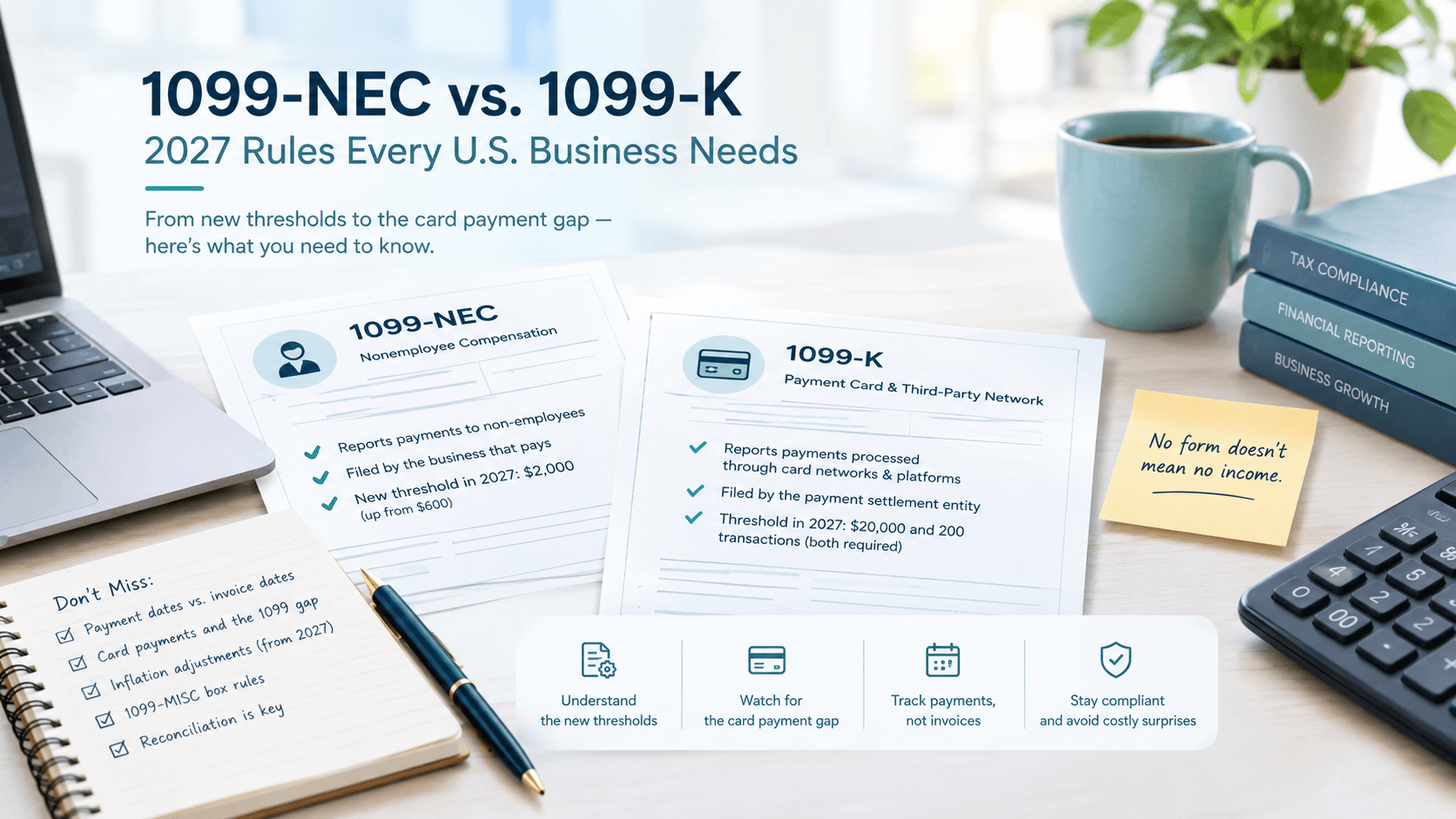
The 1099 threshold has been updated, and a lot of business people need to be educated on how that has impacted things.
Under federal law, the threshold for most payments made by way of a 1099-NEC or 1099-MISC has changed from $600 to $2,000. This will affect payments that will be due starting in January 2027.
The change leads to two common mistakes among businesses—the first one being to continue sending out forms as before and the second one being to stop requesting W-9s altogether and panic when the vendor goes over the threshold in December.
In practice, businesses should keep collecting W-9 forms from all vendors and perform checks now. Finding a mismatch in October gives businesses enough time to fix the problem while finding it on January 28 puts them at a risk of penalties. Double check with your CPA as far as the rules are concerned.
Verify sales tax nexus before influx of Q4 sales.
During Q4 is considered the peak season for retail and e-commerce. However, businesses may unknowingly exceed nexus thresholds, with the following points causing frustrations.
- Some states use two different methods to determine threshold, while others only use calendar years.
- The fact that a number of states abandoned the transaction count dictates that only income is used while other states still use both strategies.
- A difference in the way that sales via marketplace transact towards thresholds.
- Remote working employees, inventories in third-party facilities, and traveling sales force may create some physical nexus irrespective of the amount of sales.
The cost of finding out in February is back-collecting tax you never charged customers. Our multi-state sales and use tax compliance service covers nexus monitoring, registrations and filings. If you sell online, the Tech & Ecommerce industry page shows how we handle those patterns.
Phase 2: Days 31–60 (November): Plan While Options Still Exist
Conduct a simulated end of the year closing on Nov 30
This piece of advice is the most important one on the list. Consider November 30 as a dry run for an end of the year closing. Draft regular financial statements and check if there’s anything alarming in them: a profit margin that has changed for the better, an expense that was eliminated from the account, or a liability that’s unreasonable.
You now have a month to fix mistakes instead of discovering them after you are supposed to be done with your books.
Timing is more important than date of purchase
Sometimes it can be better to postpone plans concerning certain purchases. Sometimes the tax advantages get connected to when an asset begins operating. Recently-released legislation returns back 100% bonus depreciation for qualifying assets and also increases the limit set by the Section 179 legislation. If you receive a machine in January, you cannot claim it in your 2026 tax return irrespective of the moment of payment.
Ask your tax team to review your fixed asset register against actual in-service dates. Our outsourced tax preparation team supports CPA firms and businesses with this kind of year-end analysis.
State elections matter
Pass-through business owners have great advantages from state PTET elections. In several states, there are requirements in place to be completed or fulfilled financially by December 31. If these requirements are missed, the benefits cannot be used for the entire year and there will be no chance of redoing the process in spring.
Make your payroll ready for new filing requirements
Federal changes in deductions connected with tips and overtime introduce new requirements for data provided to payroll. Your system must set up new pay types in order to prepare correct year-end documents. Reconcile your quarter filings with the general ledger now, and not wait until January and W-2s.
Review unclaimed property
This is not a frequent item in checklists. Payroll checks that are not cashed, vendor refunds that have become stale, and credits from customers that are not used become unclaimed property that needs to be reported to the various states. Each state has its own reporting calendar. The penalties and interests incurred from failure to report may be high, with many businesses not even realizing that they hold these funds. Taking time today to review older checks is a good way to avoid receiving an audit request in the future.
Phase 3: Days 61–90 (December): Lock the Year
Cutoff is the point where errors are camouflaged
The last two weeks of December characterize cutoff: ensuring that revenue and expenditures are appropriately allocated to the right year. Key elements:
- Accrued expenses and unpaid invoices to suppliers
- Prepaid items such as insurance and software subscriptions
- Revenue that will be recognized in future and amounts received from customers in advance
- Count of inventory and obsolete stock
- Credit memos and refunds issued towards the end of the year
The situation is different in different industries: the construction industry uses work in progress reporting whereas the retail industry relies on inventory data, and the SaaS industry makes use of deferred revenue.
Begin preparing for audits and reviews in advance
If a review, audit or lender’s inquiry is likely, start compiling the documentation now, including bank statements, schedules, contracts and the justification for major expenses. Doing this in December is much cheaper than having to deal with inquiries in March. In search of additional capacity, certified public accountant firms suffering from lack of audit personnel may resort to outsourcing this task.
Prepare the budget for the following year before January
Most companies elaborate their budgets in January. They should really do this in December when the experience of the previous year is still fresh. Even a simple report with projections of sales revenue, changes in personnel and cash flows is useful for the company because it provides benchmarks for its performance right from the very first day of the new year. A virtual CFO and FP&A services can be used to generate and update the model monthly.
What Many CPA Firms Don’t Realize About Busy Season
Accounting companies are very meticulous when it comes to tax season. Some trends in the industry might escape your attention.
1. The real problem originates not in preparation but from having a set of books that are ready for the client to use.
In January, when disorganized records come from clients, the senior personnel have no choice but to spend it doing cleanup instead of reviewing those records. Shifting the cleanup into November and December saves a company a lot of money. Businesses that hire bookkeeping specialists as early as possible are able to expand their customer pool without hiring any new full-time employees.
2. Learning the ropes takes some time.
Beginning a partnership during an intensely busy season means that a company has to teach its new workers while handling numerous deadlines. Initiating this process earlier, at least in October, will help ensure that new hires become familiar with the company’s workflow. See our Hire Bookkeeper / Accountant and Hire Tax Preparation Staff pages for more information.
3. Officials engage in data verification
Tax filing entities leverage data from diverse channels such as the income declared in the tax returns as well as data from ecommerce transactions and sales and use tax returns. The discrepancies between what a taxpayer files on the income tax return form and what is reported to the states can be uncovered after years. Harmonizing those amounts before filing tax returns is inexpensive insurance.
4. Various clients require various services
Some clients are in need of reconciliation while others just require compliance. Hence, it’s a good idea to classify your clients into these three groups too early rather than treating them the same way.
Where Xconcile Fits In
If you read this and thought, “I don’t have the time or people for all of this,” you’re not alone. That is the reason outsourced finance teams exist.
Xconcile works with U.S. businesses and CPA firms as an extension of their own team. The services mentioned above cover day-to-day bookkeeping, payroll, tax preparation, multi-state sales tax, audit support and virtual CFO work, all delivered by US GAAP-trained professionals.
You can explore the full range on the Xconcile website, or schedule a meeting to talk through your year-end plan. The sooner you start, the more of these 90 days you’ll have to work with.
This article is for general information and isn’t tax or legal advice. Tax rules change and vary by state, so confirm details with a qualified professional before acting.