

QuickBooks can be utilized by a medical practice, a contractor, and a software startup. However, the books shouldn't be similar for these three types of businesses. Yet, too often, accounting systems ignore the differences across industries.
This leads to financials that "equal" but do not convey much meaning as well as tax strategies built on wrong assumptions.
This article discusses the main traps of each industry, some tax and compliance issues that even experienced CPA firms might miss, and how Xconcile fits into the solution.
Healthcare: Revenue Isn't What You Billed
The cost of care is $100,000. Insurers will not cover all that amount, so some of that will have to be paid by the patient as co-pay. Financial records tell nothing of denied claims, accounts receivable, or money collected.
The principles of healthcare accounting revolve around the use of ERA/EOB forms, revenue cycle management, and accrual accounting for unrecorded services. The situation is complicated even more for medical spas as they have to keep separate records for medical and retail services.
Xconcile’s Medical & Health area of expertise provides services for all healthcare fields including general medicine, dental, behavioral health, and home healthcare. It signs BAA agreements and certified SOC 2 Type II delivery services.
Real Estate & Construction: Profit That Exists Only on Paper
Billed stages by contractors mean the use of retainage and include charges for variation orders. In absence of work-in-progress schedules, it is actually possible for a job that seems to make money to end up going into the red, while over- and under-billing camouflage the phenomenon in the balance sheet.
The conundrum for developers, however, is rather different as they have to capitalize both soft costs and interest, reconcile the drawdown of the construction loan and do waterfall distribution of convertible entities.
Here is a tax detail easily missed: Section 179D (deduction for new energy-efficient building) was designed to expire under the law passed in 2025 for buildings which will start being erected after June 30, 2026, so clients embroiled in projects near that deadline should be investigated right now.
It is noteworthy that bonus depreciation has returned to 100% for qualifying assets bought starting January 19, 2025, thus changing the importance of cost segregation studies. Thus, it should be checked with each client.
Tech & E-commerce: Cash Isn't Revenue
A customer pays $12,000 for an annual subscription upfront. According to ASC 606's standards, this amount is classified as liability upon signing, which should be recognized every month on a proportional basis as the related service is performed.
In the e-commerce sector, the same issue occurs due to marketplace payments, because revenue is recorded as deducted of the fees, returns, and chargebacks.
An important nuance: domestic research expenses will become deductible after the tax changes of 2025; however, foreign expenses would still remain capitalized for 15 years. Hence, if the developers are located overseas, the taxation will be applied differently than if they were based in the USA.
Xconcile’s Tech & Ecommerce page guide presents deferred revenue waterfalls, SaaS metrics (CAC, LTV, churn), Stripe and Shopify reconciliation, tax credits, 1099 or W-2 classification for global employees.
Hospitality & Retail: The Deposit That Never Matches
The point-of-sale system shows an amount of $10,000, whereas the bank account shows an amount of $9,640. The difference comes from the charges that are incurred and the money that is not accounted for. It is therefore a mystery at the end of the month.
Xconcile is a provider that specializes in Hospitality & Retail practice operations. Their solution integrates POS with e-commerce and payment processors, streamlining reporting across multiple locations, and monitoring hundreds of expenses.
Three Compliance Traps Hiding in Plain Sight
1. A remote hire can be a tax event.
Making an employee work in a new state grants the employer the responsibility of handling the unemployment insurance registration of employees, taxes, and providing a footprint for sales tax liability. The payroll and tax departments are seldom in contact with each other, and hence there is no awareness of this ever-growing issue. A solution to this problem is provided by Xconcile. The Payroll & Compliance department of Xconcile takes care of multi-state registrations, and the Sales & Use Tax service tracks the implications of remote employees on nexus.
2. Inventory in someone else's warehouse counts.
Amazon FBA stores your goods in many states, and that can create a physical nexus you never chose. Add economic nexus (commonly $100,000 in sales or 200 transactions, though a growing number of states have dropped the transaction test) and you get "one business, fifty sets of rules." Thresholds change, so a nexus study from two years ago may be stale.
3. Reporting thresholds moved.
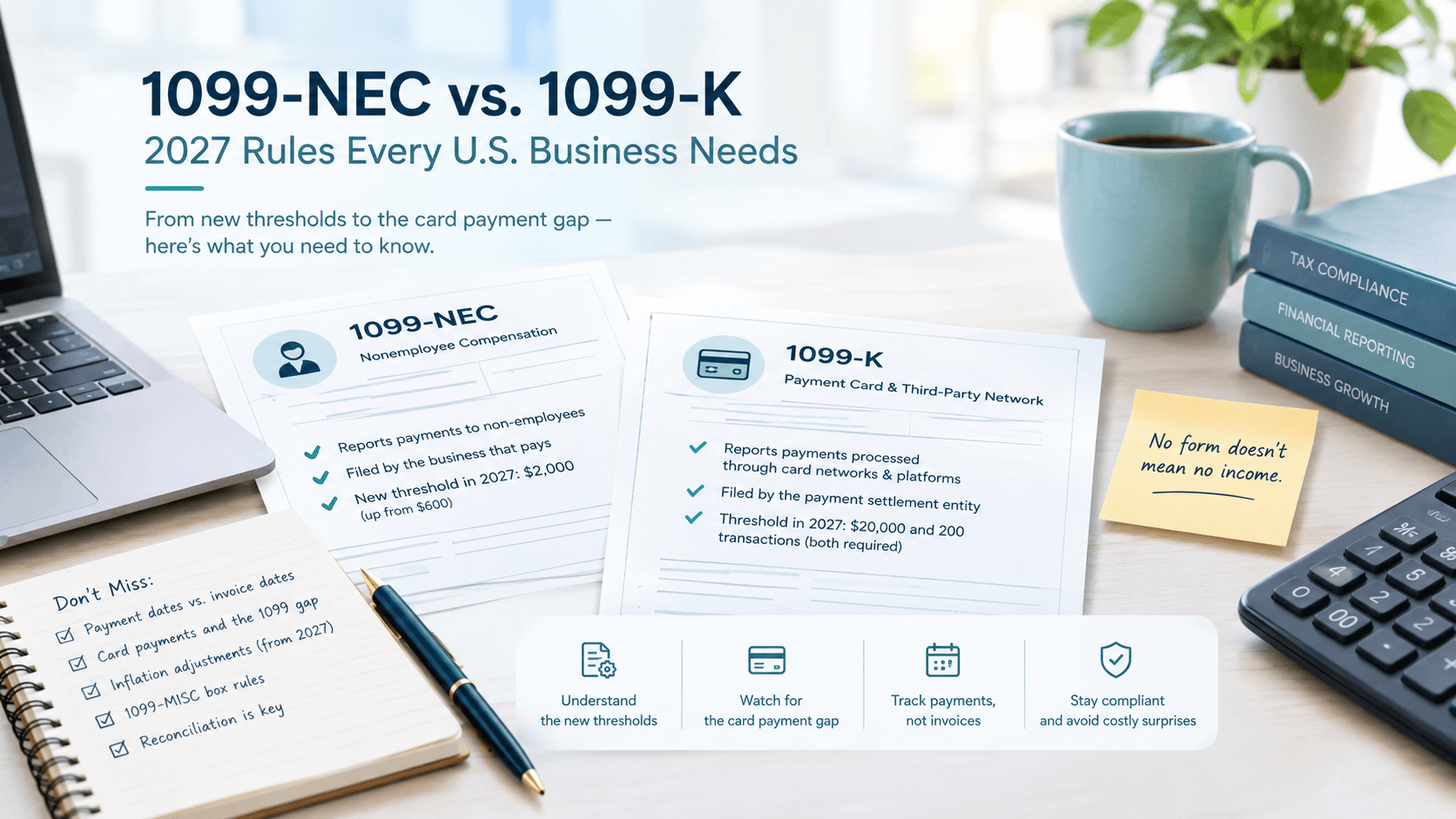
2025 legislation adjusted the 1099-NEC/MISC threshold (for payments made in 2026) and rolled back the 1099-K threshold. Check your onboarding checklists against current numbers.
For CPA Firms: What Rarely Gets Discussed About Outsourcing
Many firms outsource for capacity. Fewer think through the compliance side.
Offshore tax return work needs specific consent.
As per the regulations of §7216, obtaining consent from the taxpayer is necessary when it comes to divulging tax-related details to an offshore tax preparer and there are some additional requirements particularly for social security numbers. A standard engagement letter may not suffice. Consult your attorney regarding the terminology you use.
Security conditions apply for vendors as well.
Tax consultants are required to establish an information security program and any partner processing client data will fall under the program. Therefore, it is legitimate to inquire with the service provider about their methods of accessing and protecting data.
The situation concerning audit personnel is a bottleneck.
Vouching, tracing, confirmations, and PBC follow-ups consume the senior team's time. The Audit Outsourcing team of Xconcile operates within the same process (CaseWare, CCH, AdvanceFlow), making planning analytics, materiality calculations, and substantive testing.
The need to book tax season staff before March is urgent.
Xconcile’s Tax Preparation service works in all major programs (UltraTax, Lacerte, CCH, Drake) using the follow-the-sun principle: one sends the data overnight. The work includes preparing forms 1040, 1065, 1120, and M-1 reconciliations.
The Layer Above the Books: Virtual CFO & FP&A
Clean books answer "what happened." Owners want "what happens if?"
Xconcile's Virtual CFO & FP&A service covers rolling 12-month forecasts, budget-vs-actual variance analysis, hiring break-even models, 13-week cash flow projections, and KPI dashboards in Power BI or Tableau. It also supports fundraising and M&A with pro-forma statements and due diligence materials. The site says this delivers CFO-level guidance at roughly 60% less than a full-time executive.
For CPA firms, this can become a new advisory revenue stream, delivered under your brand.
A Five-Minute Self-Check
- Can I explain last month's cash movement, not just profit?
- Do I know every state where I owe sales tax or payroll registrations?
- Do my reports use my industry's real metrics (WIP, RCM, ASC 606)?
- Is my consent and data-security paperwork current for outsourced work?
- Could I absorb a surge of new clients tomorrow?
Each "not sure" is where a better process starts.
See What Your Numbers Are Hiding
Whether you run a business that needs cleaner books and compliant filings, or a CPA firm that needs dependable, scalable capacity, Xconcile builds around your workflow rather than replacing it.
Schedule a free consultation or explore the full list of services and industries to find your fit.
Disclaimer: For educational purposes only; not tax or legal advice. Tax thresholds and deadlines change, so confirm current rules before acting.