

There is one common question that has been left unasked in December by most business owners; “If my CPA checks my financial records tomorrow, how much time will he take to see if they can even be deciphered?”
For most small businesses, the answer is in the range of ten to twenty hours (money paid to the CPA). This time could have been invested in planning for the next business year rather than paying for services already rendered in the last business year.
The twelve points discussed in this article will help you prepare your books of accounts before New Year’s celebrations begin in 2027. Each point includes a little detail that can easily be overlooked even by experienced accountants.
1. Reconcile Every Account, Not Just the Bank
Most business owners do a reconciliation of checking but don’t go further. Year-end reconciliation includes ensuring everything balances for credit cards, loans, PayPal, Stripe, Square, and everything else you have lying around dusty and idle.
Important fact: A dormant account still being fed into your accounting system is still sending unposted transactions to your balance. Make sure this account is reconciled out or zeroed out.
Ongoing reconciliation is also necessary for outsourced accounting and bookkeeping, and it is one of the first things in the clean-close process.
2. Clear the "Junk Drawer" Accounts
Make sure to examine in detail the accounts of Uncategorized Income, Uncategorized Expenses, Ask My Accountant, and Undeposited Funds. If you find something in these accounts, your report is probably incorrect.
Note: an unusually high amount of money in the Undeposited Funds account means that the customer payments were recorded but not linked with the deposits, thus making your accounts receivable overstated which might also lead to overstated revenues. The good news is that account cleanup would take less time than correcting item by item in the future if the balance is large.
3. Collect W-9s and Verify 1099 Thresholds
If you did not collect W-9 forms throughout the year, do so at this time. It will be much easier to do so now than to chase vendors come January.
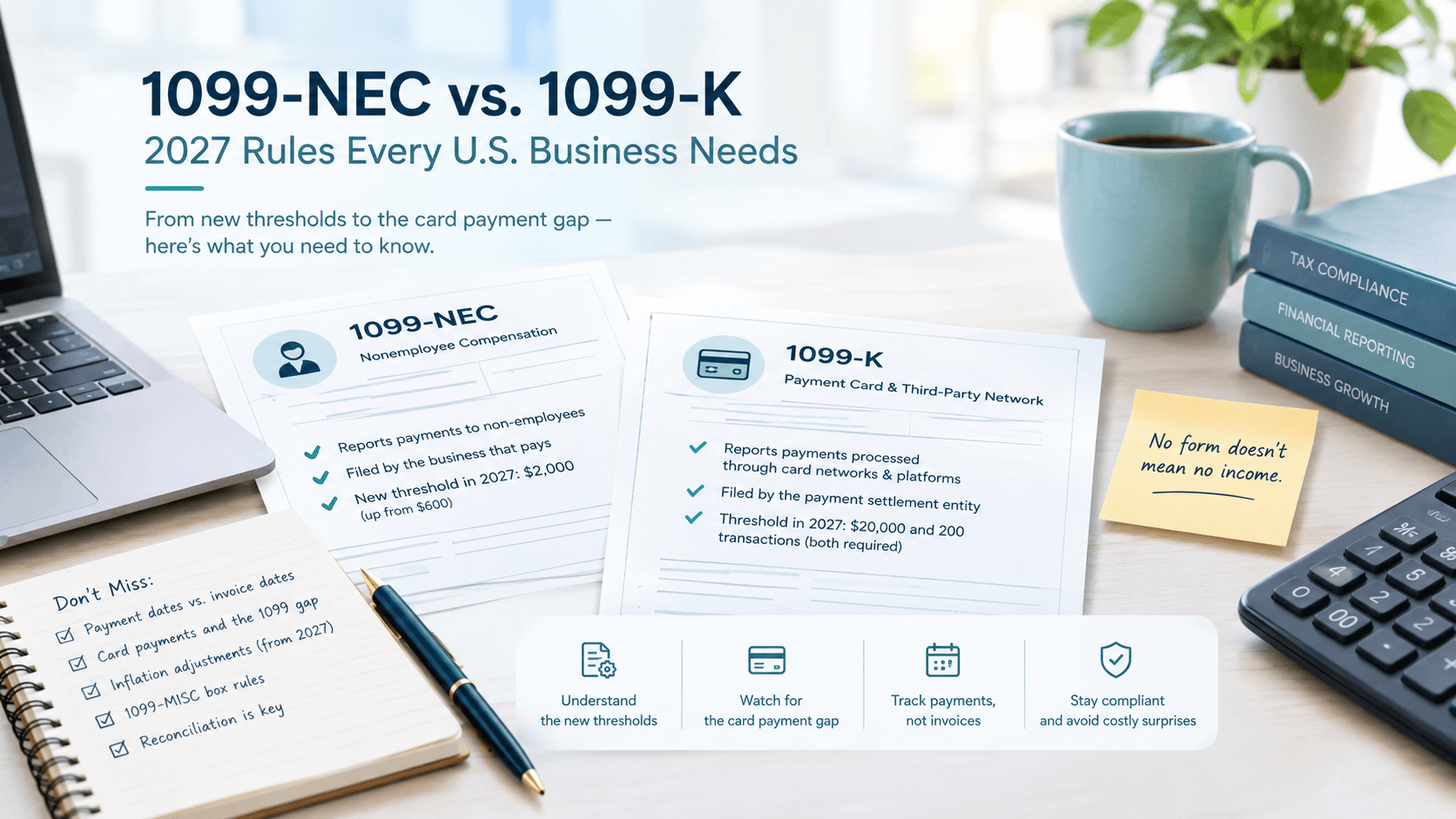
Note: The federal 1099-NEC and 1099-MISC reporting threshold has increased from $600 to $2,000 for payments made in 2026, but many owners and assistants still operate by the old number; there may be instances where some states have lower thresholds.
Using someone for payroll and compliance support along with the data will ensure better organization of contractor data and clean 1099 information for tax preparer.
4. Get Year-End Payroll Right Before the Last Pay Run
Since Jan. 31 falls on a Sunday, W-2s are due to employees and the SSA by Feb. 1, 2027. It is best to make the adjustments prior to processing final payroll in December.
An important consideration: Health insurance premiums paid by the company need to be included as wages. This is especially important for S-corporation owners who own more than 2% of the company. If you do not process this through payroll, it can result in complications later. Additionally, new deductions for qualified tips and overtime make it necessary to check your payroll system to ensure these amounts are being treated correctly.
Our payroll and compliance services handle this, or you can hire dedicated payroll staff.
5. Review Sales Tax Exposure Across States
multi-state sales and use tax compliance can be the sole factor in establishing economic nexus without the presence of an office nor any employees. Businesses engaged in the online selling of goods and services may reach a state’s threshold without realizing it.
The nexus liability is inapplicable for the period when the business is not aware of its liability. Year-end review of sales made in each state is an inexpensive way to identify potential nexus problems early.
6. Update the Fixed Asset Register
Did you buy a truck, laptop, or equipment this year? Ensure each purchase has been capitalized properly and recorded.
Keep in mind: Section 179 and bonus depreciation usually require assets to be put in service by December 31, not just ordered or paid for. Assets that are stored in a storage facility as of December 31 will not qualify for 2026.
Also, think about the written capitalization policy, as well as de minimis safe harbor election (usually $2,500 per purchase for companies without audited financials). You will have to provide your tax preparation team with the receipt for them to make those decisions.
7. Count Inventory and Reserve for Shrinkage
The figures for the book inventory and the physical inventory seldom match one another. Inspect the inventory by the end of the year and then modify it for expired, obsolete, or damaged goods.
The documented detail: Higher inventory will lead to fictitious profits, meaning that you might pay taxes on fictitious profits. Retail markets, hotels, restaurants, and online shops are most exposed; our team of professionals working for hospitality and retail and tech and ecommerce is faced with difficulties every single day.
8. Match Payment Processor Payouts to Revenue
With Stripe, Shopify, Square, and Amazon, the deposits made to merchants are always netted of fees and refunds. If you book the deposited amount as revenue, your gross sales and expenses will be understated.
You should not forget that payment service providers report the gross number of transactions on Form 1099-K. If, however, the deposit amounts you are reporting are reflected as net amounts in your books, your revenue will not match the amount reported on Form 1099-K.
The threshold amount, as well as the number of transactions required to be reported on Form 1099-K, has changed, meaning there will be fewer forms to be filed with the IRS.
9. Book Accruals, Prepaids, and Deferred Revenue
For businesses that sell annual subscriptions, retainers or prepaid services, cash received doesn't always mean revenue earned. The annual insurance premium invoice received in October covers part of the year 2027.
Unnoticed thing: Whenever companies apply for loans, receive investments, or find buyers, they tend to favor accrual basis accounting despite their tax returns being on a cash basis. If you follow accrual accounting principles, you will not be forced to retroactively correct your financial statements. Consulting services of an outsourced virtual CFO and FP&A team will help you determine the suitable accounting basis in accordance with your needs.
10. Clean Up Owner Transactions, Loans, and Equity
The owner draws, shareholder loans, reimbursements, and personal expenses charged on the business account may often be incorrectly classified as miscellaneous expenses.
Important note: With partnerships and S-corps, loan basis determination affects the number of losses that can be deducted by owners. Problems associated with bad shareholder loans lead to disputes. Establish advance reimbursement plans and record any loan agreements. Involve your tax preparer beforehand or even hire tax preparation staff if your organization is overburdened with work during busy periods.
11. Review Receivables, Payables, and Stale Items
Examine old accounts receivables for uncollectable billings except for entries that were omitted for payable accounts.
An often-missed detail is that accrual accounting businesses need to write off bad debt during the year in which it becomes uncollectable before a deduction can be claimed. Also, old or uncashed checks from suppliers or payroll can be considered unclaimed property and reported to the states. However, many business owners have no idea of this obligation. Therefore, a year-end review like this is an integral aspect of audit outsourcing and support.
12. Close the Period and Build Your 2027 Baseline
After completing all aspects of your financial process, it's time to lock the books. Locking up books ensures that no inadvertent changes are made to the numbers already recorded.
Take note of the fact that your locked-down year would offer you the best budgeting solution. Compare your actual statistics with your projected numbers, highlighting the top five expense areas that increased most and setting targets for 2027. The virtual CFO can turn that cleanup operation into a forecasting and cash flow model, and dedicated CFO hire will help you achieve that with minimum costs incurred.
What CPA Firms Often Underestimate About Year-End
Here's something that accounting firms may not be quick to reveal: tax preparation is not the major issue the way the accounting state look like when they arrive.
Clients tend to present inaccurate records in January, which means that the staff members lose the most important weeks of the busy time for reconciliation instead of performing the more valuable work that companies should be doing. This can be solved by doing the necessary work earlier at the end of the year with the capacity that does not require permanent staff.
The answer is Xconcile. Our trained staff works as an extension of your team on bookkeeping, accounting, payroll, tax, audit support, and CFO advisory. Our Hire Our Staff solutions make it possible to hire accountants as needed and without going through lengthy recruitment procedures.
Your Next Step
You have about three months. Don't try to do all 12 items in the last week of December. Start with items 1, 2, and 4, since they affect everything else, then work down the list.
If your books already feel behind, or your firm needs extra hands before the rush, talk to us:
- Schedule a meeting to walk through your year-end needs
- Contact our team to request cleanup, tax, payroll, or CFO support
Tax rules and thresholds change and vary by state, so confirm details with your CPA before acting.