

There are less than 90 days that remain in the year 2026. Many business owners think that the hardest part about the process is choosing a product to purchase and identifying a deductible expense. This is incorrect. The most dangerous part belongs to the details usually omitted by journalists: the day on the delivery slip, the payroll number, and the vendor form that nobody took into account.
By reading this article till the end, you receive answers to the questions below:
- When are purchases not equal to deduction?
- What payroll number can bring about penalties in January?
- How can a higher 1099 threshold create more mess in your accounting books?
"Permanent" doesn't mean "automatic"
The 2025 tax law (the One Big Beautiful Bill Act, which the IRS now calls the Working Families Tax Cuts) made several business provisions permanent. 2026 is the first full year you'll feel them. But every benefit below depends on clean records to claim it, and that's where most problems start.
1. Equipment write-offs: the date that matters isn't the one you think
100% bonus depreciation is a permanent phenomenon now if the property is acquired after January 19, 2025. The limit of 2026 Section 179 stands at $2,560,000, and it phases out once the purchases are above $4,090,000. It appears easy and simple. However, here are some things that are missed:
- Placing a property in service wins over paying. Getting your equipment paid but is still warehoused on December 31 does not earn you anything for the year 2026.
- 179 and bonus are not the same thing. Section 179 has a limit that depends on the taxable income of the business. Bonus does not have any limit, and can surpass the limits thus causing losses that will influence QBI and cash flows.
- Bonus is a default option. Unless you opt out from bonus by asset class, it automatically gets applied for you and could cancel your previously planned strategy.
- Some states do not comply with the mentioned regulation. In cases of state decoupling, you have to carry out double depreciation accounting that outlines the gap.
This is where Outsourced Accounting & Bookkeeping and Outsourced Tax Preparation work together. One keeps asset records audit-ready. The other helps model federal versus state outcomes before you sign a purchase order.
2. QBI: the quiet upgrade
The Qualified Business Income deduction of 20% is a permanent provision. In 2026 the threshold for the wage limits and also for the limits on specified-service will be expanded to $75,000 for singles and $150,000 for couples. Individuals who are actively participating must make at least $1,000 in qualified income to qualify for the deduction.
However, the criteria for QBI withholding is dependent on several factors which include pay of the owner, W-2 salaries, income classification and guaranteed payments, which must be accounted for during the year. For S-corporation partners, salaries must be processed during the year if they are to be qualified for QBI.
Modeling this before December 31 is far cheaper than amending in April. An Outsourced Virtual CFO & FP&A team can run the scenarios, and Outsourced Payroll & Compliance Services can execute the true-up cleanly.
3. The 1099 reset: higher threshold, new traps
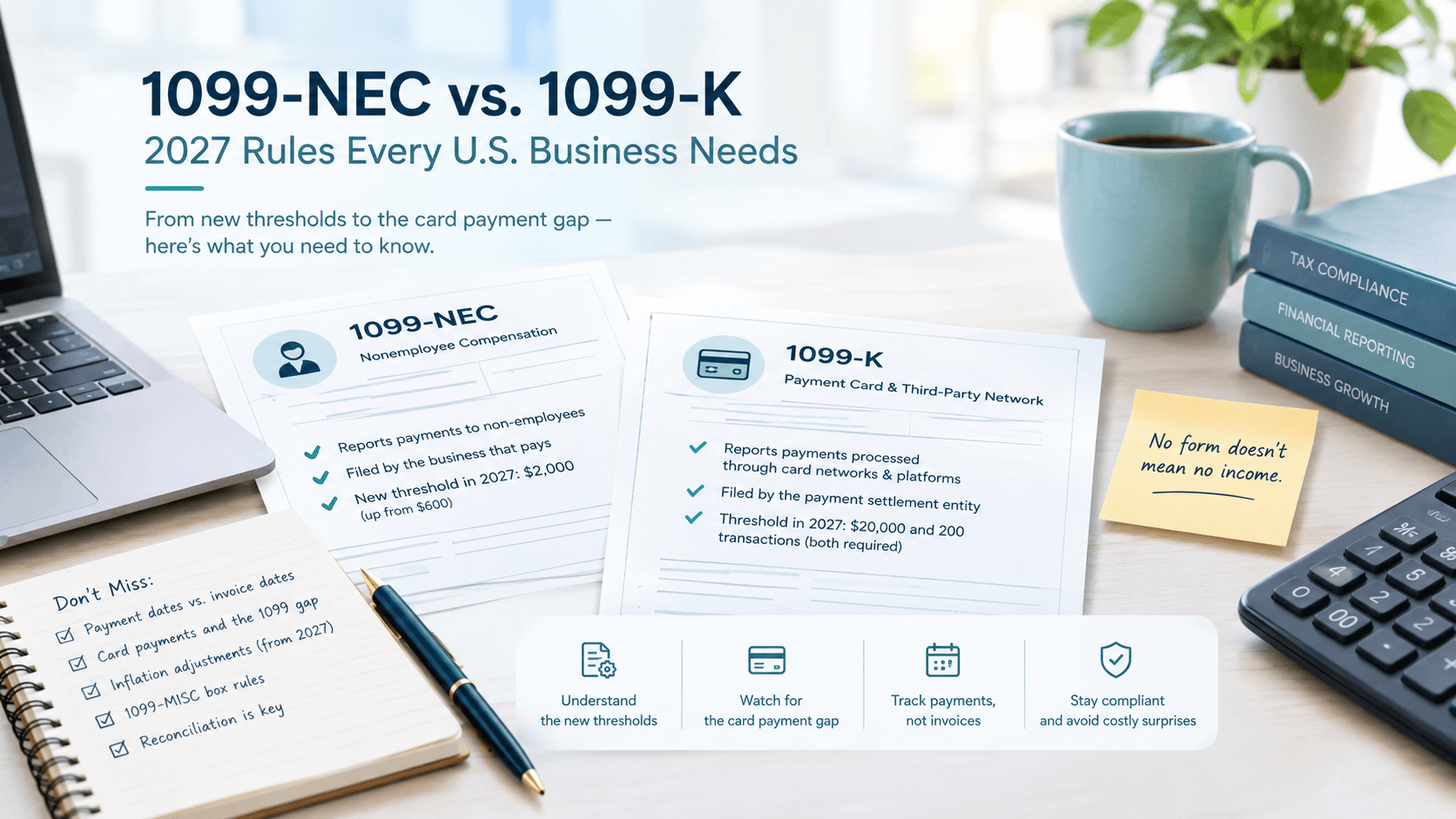
Regarding payments in 2026, the 1099-NEC and 1099-MISC thresholds will be increased from $600 to $2,000, and forms have to be submitted in early 2027. The 1099-K threshold decreases to $20,000 and 200 transactions, and backup withholding is on its way. However, certain conditions need to be checked:
- Not all types of payments have been amended. There are other rules for certain payments, e.g. gross proceeds to lawyers.
- States have their own regulations and criteria. Some of them have different threshold values.
- Software advances might be insufficient to keep up with the new rule. Your accounting program might still identify vendors under the old threshold.
- Make sure to get W-9s from vendors. A vendor crossing the line without valid TIN will cause the backups of 20%.
- Fewer 1099-K leads to fewer cross-checks. Income remains taxable; your accounts have to establish an income connection to processors and bank deposits.
For online sellers, this issue is even more relevant. Look at how Xconcile helps Tech & Ecommerce companies and why Multi-State Sales & Use Tax Compliance is essential.
4. Payroll: the code that could cost you in January
This is the situation that many business owners do not anticipate if they do not keep current with Federal Labor Statutes or IRS Guidelines. Effective from the year 2026, employers are required to report qualifying overtime in Box 12 of W-2 generated using Code TT and qualifying tips using Code TP. The problem with Code TT is that it only includes half the qualifying time-and-a-half payment as defined by the FLSA. The current payroll process of mixing all overtime categories will need to be redesigned.
- Overtime will still be subjected to withholding. Therefore, employees will have to take the deductions into consideration while updating their W-4 for the year 2026.
- The full amount of qualifying payment has to be reported even if the amount of deduction allowed is lower than the payment.
- In case of reporting mistakes, W-2C will have to be submitted and consequences faced.
The report must be generated at the earliest.
Not sure your provider separates the premium? Talk to our payroll compliance team, or consider dedicated help through Hire Payroll and Compliance.
5. R&D: stop capitalizing out of habit
With the advent of Section 174A, any domestic research and experimental development costs incurred in any tax years ending after 2024 can be deducted in full or amortized over more than 60 months. However, foreign research costs will still be amortized over 15 years. Although many companies keep using the five-year schedule without even checking it, when this legislation goes into effect, they may finally have all sorts of opportunities to utilize the new regulation within the tax years coming between 2022 and 2024.
But there is a catch - proper documentation of wages to contractors and supplies must be kept by project as well as a change in the accounting policy. With regard to CPAs, this occurs at the time when end-of-the-year planning is at its peak.
6. Check what your budget still assumes
Certain incentives have already expired. The commercial clean vehicle credit was eliminated for vehicles placed in use after the end of September 2025, while, in addition, the statute provides restrictions on the filing of the Employee Retention Credit for 2021’s third and fourth quarters. In case your forecast or account receivable figures are still tied to this, you should update your forecast and substantiate it before the year’s end. Such unsupported estimates will draw strong scrutiny from reviewers, and the Audit Outsourcing Services can help CPA firms conduct stress tests of such estimates.
A 10-minute year-end reminder:
- Confirm placement-in-service dates and update the fixed-asset register
- Decide on the use of bonus depreciation by asset class
- Determine S-corp owners’ wages and perform pay cycle true-up
- Reset 1099 thresholds and look for lost W-9s
- Make sure payroll can isolate overtime pay (TT) and tips (TP)
- Reconcile deposits from processors to sales
- Go through R&E schedules and determine state compliance
For a deeper walkthrough, read 90 Days to Year-End: The Accounting Roadmap for U.S. Businesses and the Year-End Bookkeeping Checklist.
Turn Q4 into an advantage
Tax law changes only pay off when your financial data is accurate, current, and ready to act on. Xconcile pairs US GAAP-trained professionals with your team across bookkeeping, tax, payroll, CFO advisory, and audit support. That works whether you're a growing business or a CPA firm that needs capacity before a busy season. Schedule a meeting or contact the team, and you'll hear back within one business day.
This article is general information, not tax advice. Rules vary by state and situation, so confirm with a qualified professional.