

Every year, companies make a resolution to make this particular busy season less hectic. However, the month of February comes in, the document portal gets clogged and the partners are up until 11 p.m. reviewing the returns.
The busy season of 2027 is different from what many firms would not realize yet. Most of the pressure would be caused due to the new filing systems and reporting rules rather than the volume of clients. In this post we will share how to act in advance, including some points that are not considered in the ordinary checklists.
The 1099 Rules Changed, and So Did the Filing System
Both shifts happen at the same moment, and companies that manage client information returns will be forced to give both equal consideration.
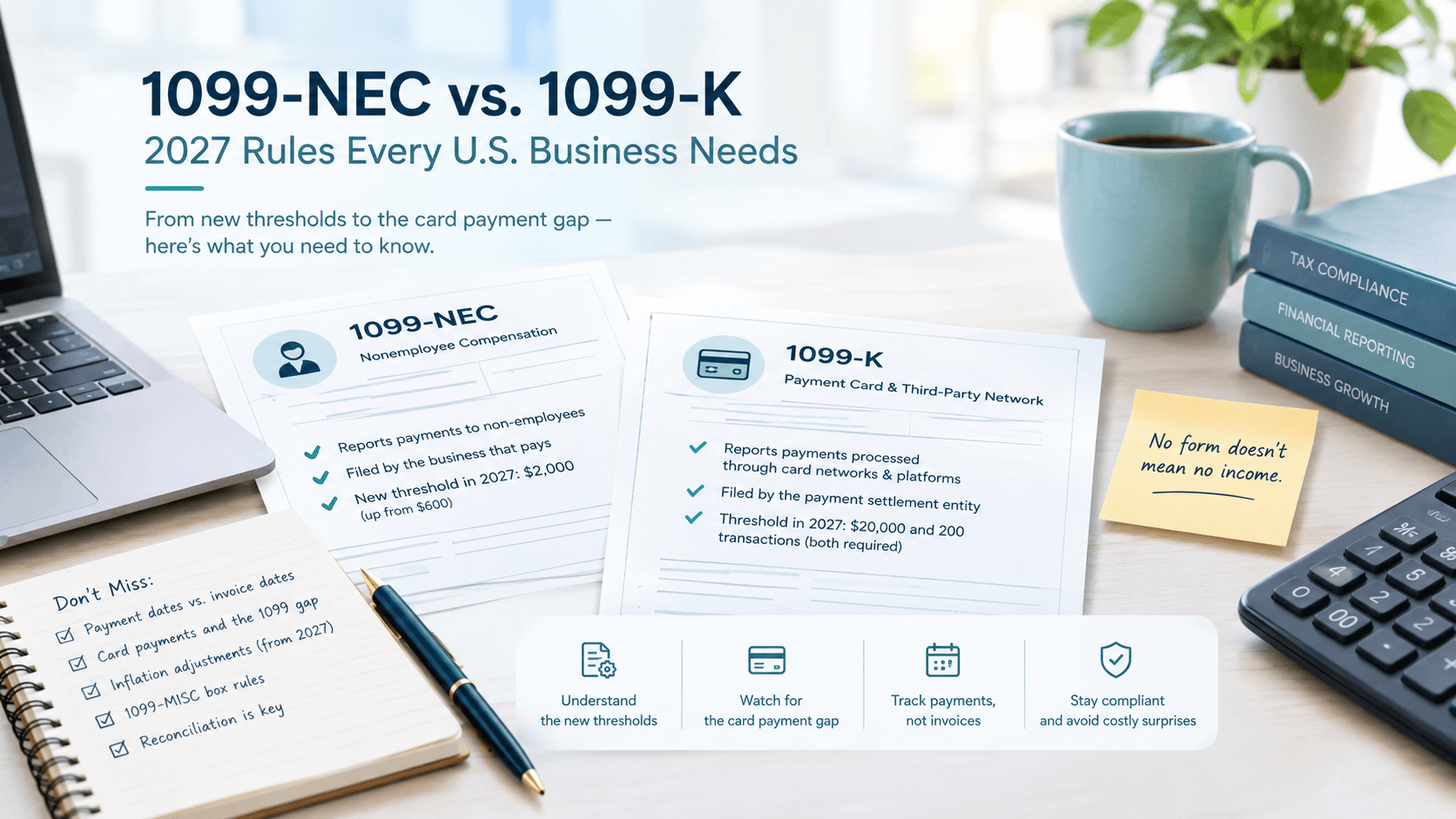
The reporting limit is raised. In December 2025 and afterward, the reporting limit on Form 1099-NEC and most of 1099-MISC boxes will be increased from $600 to $2,000. This is the first amendment to the sum since 1954, and it will be adjusted according to inflation starting from 2027. The Form 1099-K limit will also revert to $20000 and 200 payments.
The system is updated. The Internal Revenue Service is decommissioning FIRE and IRIS will be the only electronic filing mechanism starting from 2027. If your company files forms 1099 for the clients, then you should have the IRIS access by January. Don’t wait for the last January week to discover how long it takes to install it.
What many companies overlook is the client who has paid a $1,500 contractor and no longer has to issue a 1099. Nevertheless, the contractor must pay tax on that income. Clients wonder if they need to still request W-9s. The answer is affirmative. The company cannot know who has made $2,000 until the end of the year, and the lack of W-9 can lead to penalties and issues with backup withholding.
Prepare a one-page advisory for the clients. It is cheap, gives clients a feeling of being served better, and reduces emails in January.
Tips and Overtime: The “Premium-Only” Trap
The new deductions on qualified tips and qualified overtime are great news for clients. Yet they tend to be mishandled.
With overtime deduction one has to consider only the part that constitutes the premium paid for overtime, the time-and-a-half part. It is not the entire amount paid for overtime by your client. If your client’s payroll system refers to every payment as overtime earnings and lumps it under this term, it is impossible for you to calculate any deductions. You will spend February gathering information that had to be acquired in January instead.
The new reporting forms carry new fields accounting for tips and overtime. The client who is not sure how to account for them correctly will shift the responsibility of pulling this together on you.
So what is the next step? Ask your hourly clients whether they have systems of accounting for premium overtime. It is wise to have it organized before it is too late, or your firm will have to spend lots of time correcting errors after the W-2 forms are provided to the clients. If your clients have payroll problems, Xconcile outsourced payroll and compliance services are made for resolving payroll errors.
Your Real Bottleneck Is Review, Not Preparation
When inquiring about the reasons behind delays during the busy season, the majority of business owners will mention the need for more workers. However, if one looks closely, they will discover that the constraint lies in reviewer capacity.
The pattern goes as follows: preparers produce drafts in batches, but there are only several managers and partners who will review those drafts. As a result, returns accumulate in the reviews. Each day of delay compresses the schedule. At some point, the last mistakes are made when everyone is already exhausted.
The way to fix the situation is to ensure that the work going to the review is of better quality, which means:
- Workpapers must be properly indexed and hyperlinked to save reviewers from searching for underlying documents.
- Underlying documents must contain references to the draft return (W-2s, 1099s, 1098s).
- The book-to-tax adjustments (M-1/M-3) must be documented prior to getting to review.
- A secondary check has to take place prior to sending any documents to partners.
This is where outsourcing earns its keep, and not only on cost. Xconcile’s outsourced tax preparation service delivers reviewer-ready files prepared in your own software (UltraTax, Lacerte, CCH, or Drake). Each return goes through a four-eye review by a senior tax manager, and because of the time-zone difference, drafts can be waiting when you start your morning. The service page cites 99% accuracy and a 40–60% cost reduction.
If you’d rather build capacity as an extension of your own team, you can also hire dedicated tax preparation staff.
Dirty Books Are a Hidden Tax on Your Season
Partners understand but seldom quantify the following: a significant proportion of tax season delays stems from bookkeeping difficulties rather than tax issues. Non-categorized transactions, unreconciled accounts, absence of depreciation schedules, and unreconciled shareholder loans postpone tax returns. Preparer cannot complete the return until the errors are fixed, and more often than not is the senior employee earning bookkeeping rates doing the job. October to December is perfect for cleaning up the mess:
- Find clients whose books were not in order last tax season.
- Get reconciling bank and credit card statements until November.
- Examine fixed asset purchases. Bonus depreciation and expenses make fixed asset accounting much more critical.
- Make sure contractor, payroll, and sales taxes records are reconciled with the general ledger.
If your own team can’t absorb the cleanup, outsourced accounting and bookkeeping support can reconcile and close clients’ books monthly, so returns start from reliable numbers. For a ready-made list to hand to clients, use Xconcile’s Q4 bookkeeping checklist.
Sales Tax Nexus Surprises Surface During Tax Prep
This one surprises businesses. When preparing the income tax return for an e-commerce or retail client, you discover sales in states where they never registered their business. By the time you find out, the exposure could go back several years.
The usual rule of thumb is that if a business has over $100,000 or does 200 transactions in a state, then it needs to register and collect taxes in that state. But the thresholds differ in states, and more states are getting rid of the transaction test.
Physical nexus is its own operational issue since it can come from having remote employees, traveling sales representatives, or storing inventory in Amazon’s warehouses. Clients generally do not realize that they have this presence.
Doing the nexus analysis before the end of the year will allow you to help your clients take the necessary steps before they run out of options. Furthermore, you will be able to charge them for the consultation instead of being caught off guard in March.
Xconcile’s multi-state sales and use tax compliance service handles nexus monitoring, registrations, and ongoing filings. If your client base leans online, its page on tech and e-commerce industries shows how that work fits into their operations.
Data Security Is Now a Tax-Season Readiness Issue
Legalities surrounding tax experts necessitate client information protection. Pursuant to the FTC Safeguards Rule, a duly-acquainted firm needs to have a written information safeguard plan. IRS Publication 5708 contains the necessary template for these.
The firm realizes belatedly that they have a written plan but it hasn’t been tested. Before working with the written information safety plan, these must be done:
- Membership verification through the use of multi-factor identification for any system that uses client data.
- Verification of access of previous employees, temporary employees, and outsiders.
- An appropriately organized method of information access.
- A step-by-step description of incidents.
- One must ask everything regarding use of data and protection measures in advance.
Think Beyond Filing: Use the Calm After the Storm
Companies that do well after tax season typically have one thing in common: they take advantage of their increased capacity to offer more valuable services.
If outsourcing gives your experienced staff more time to focus on important projects, use some of that time to pursue:
- Advisory work. Outsourced virtual CFO and FP&A support lets you offer forecasting, budgeting, and cash-flow planning without hiring a full-time CFO.
- Assurance work. Audit and review engagements are labor-intensive and seasonal. Audit outsourcing services can add capacity without permanent headcount.
The companies that are signing new clients by 2027 are not the companies that simply survived the busy season. Nor are they the ones who waited until it was over to capitalize on it.
The Takeaway
The firms that struggle in 2027 won’t lack effort. They’ll lack lead time. The new rules are manageable, but only if you act while there’s still room to act. A cleaner pipeline, a lighter review queue, and a team that’s trained before the rush all start in the next few weeks, not in February.
If you want a second set of eyes on your capacity plan, Xconcile works with CPA firms across the U.S. on tax preparation, bookkeeping, payroll, sales tax, audit support, and virtual CFO services. Schedule a meeting to map out where outsourcing could take pressure off your 2027 season, or contact the team with your questions.