

Each January, the same scenario takes place in accounting offices throughout the United States. A client declares, "the books are done." A member of the accounting staff opens the file and, within one hour, finds a large outstanding amount in Undeposited Funds, a payroll liability disconnected from the 941, and a vendor who was compensated thousands of dollars without a filed W-9.
These are not problems that appeared in January. They are issues from Q4 that nobody focused on in Q4.
With the year-end period ending, this checklist presents ten reviews that help draw a fine line between a smooth tax season and a messy one.
Reconcile every account, then look at what’s been sitting there
The majority of organizations conduct reconciliation of bank and credit card accounts. Lesser organizations make an effort to check the actual state of the reconciled balances.
Outdated checks don’t simply take up space in the company document. The checks that weren't cashed can subsequently become unclaimed property. Different states have different rules regarding unclaimed property. Therefore, it's crucial for companies to act on stale checks and correct the situation before the end of the calendar year.
In addition, do make sure that the reconciled amount matches the statement amount exactly, not just approximately.
Empty the four “parking lot” accounts
Verify the following 4 accounts: Uncategorized Income/Expense, Ask My Accountant, Opening Balance Equity, and Undeposited Funds.
Undeposited Funds is the trickster. By adding bank-feed deposits manually and matching them to invoices, revenues or receivables may become overstated without any warning. Therefore, any account consistently seeming to have a positive balance means it may have been counted twice.
The good news is that you should be able to count on zero balances at the end of the year. If all the work is done by your existing accountant/bookkeeper or in-house staff, you might want to hire a professional bookkeeper or accountant to keep this from happening.
Cut off receivables and payables cleanly
The end of the year comes down to realizing earnings and expenses at the correct year.
Receivables: Check your aged debt report. For those using the accrual basis accounting, the bad debt expense commonly requires the bad debt to be worthless and written off on the books in the current year, so make the review before the end of December, and not in March.
Payables: Hunt for the unrecorded liabilities. Look for the bills and payments in January for the December work services. Everything that should pertain to the old year should be accrued.
A detailed review of your aged account receivables helps in finding out which clients hamper your cash inflow. This is the kind of analysis that goes into the collection strategy of the virtual CFO and FP&A support service.
Tie payroll to the tax filings before W-2s go out
Make sure that your payroll register matches with the corresponding entries in the general ledger and that these two records are similar to the quarterly Forms 941. It can help to identify possible mistakes before W-2s are sent (they are due after January 31). If there has been a mismatch discovered in December, it can be fixed with a simple journal entry, while mistakes discovered in February usually result in filling out a Form 941-X.
Be aware that changes in federal tax laws might have introduced new reporting rules regarding tips and overtime. If your payroll system does not monitor those separately, you might have to do extra work with W-2 calculations. Follow the IRS recommendations.
Our outsourced payroll and compliance services include this reconciliation, and you can also hire dedicated payroll staff for in-house-style support.
Re-check your 1099 rules (the threshold changed)
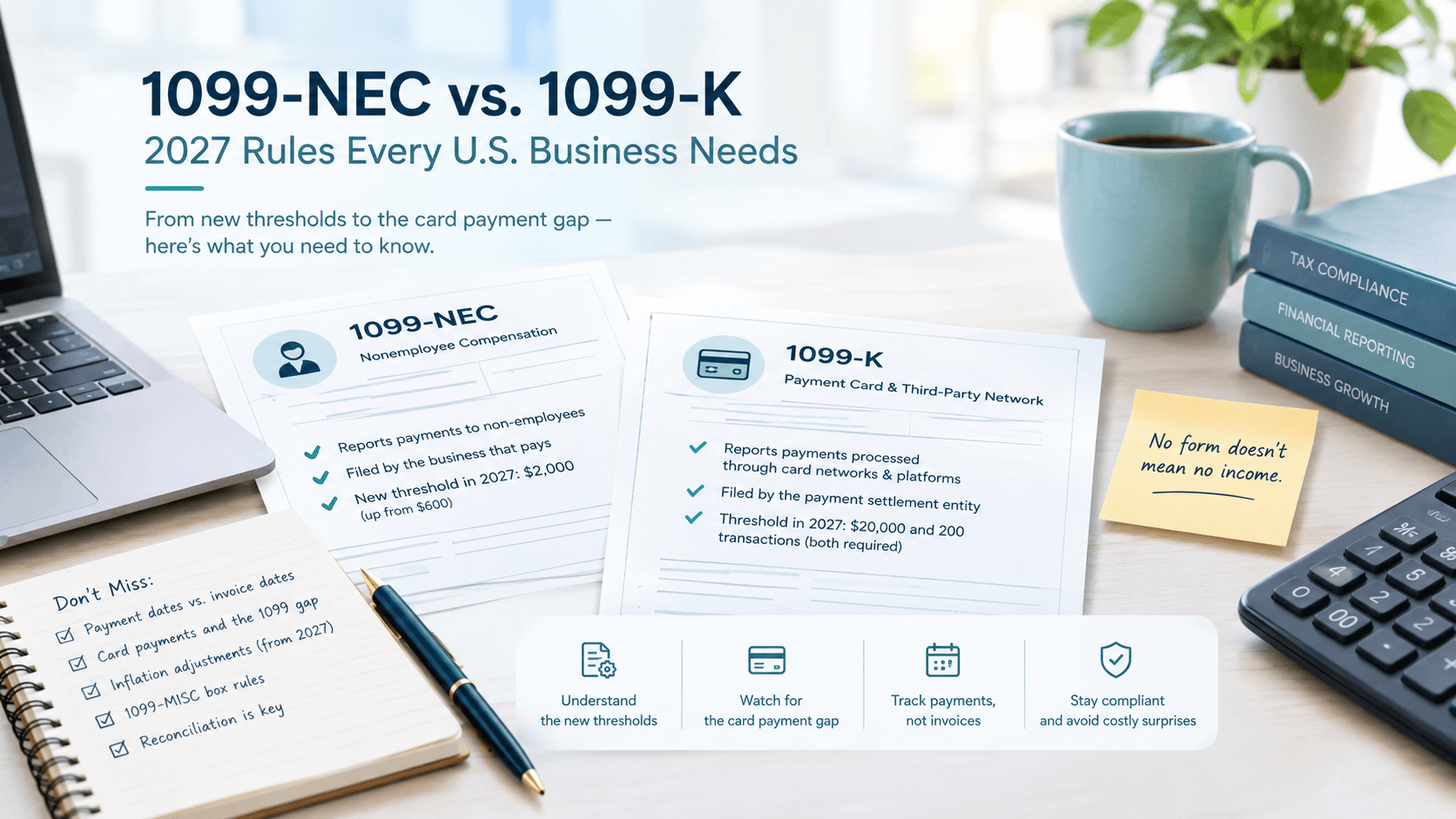
This is a detail that surprises and catches many teams unawares. The reporting threshold for 1099-NEC and 1099-MISC payments in the year 2026 has escalated from $600 to $2,000. As many systems are still loaded with outdated figures, this means that businesses are either overreporting or designing their procedures based on antiquated values.
Two more validations:
- Have you ensured you possess a W-9 for every vendor you will report? The absence of TINs entails the necessity of backup withholding at 24%.
- Have you categorized payments in conformity with their type (for example, legal fees in comparison with other services)? Not all payments are equal in nature.
Our outsourced tax preparation team can handle vendor compliance and filing end to end.
Audit your sales tax footprint, not just your sales tax returns
Numerous companies balance the sales tax payable account but do not go beyond that. The crucial concern is whether a business owes taxes or not.
Since the decision in 2018, the concept of economic nexus has become more widespread. Now, there are some states that only consider dollar thresholds. This means a business can get nexus without passing any transaction test. Immediate employees in other states can mean physical presence in that state along with payroll and corporate taxes.
Look at your 2026 sales in the states and registration. Then confirm the sales tax payable account with the amount that has already been filed. Unregistered states often cause business liabilities that need to be reviewed.
Review fixed assets and your capitalization policy
Under the current taxation laws, purchasing capital assets is now highly advantageous, and businesses can take advantage of 100 percent bonus deduction for the qualifying property purchased after January 19, 2025, and higher limitation for Section 179 deduction. The only downside of this rule is that the business has to have records regarding the purchased assets.
Review your repair and maintenance costs section, supplies section, and office expense account of your business to indicate expenses that fit the scope of capitalization of costs. Take into consideration the de minimis safe harbor.
Taxpayers making this election need to do so each year on tax return, with the amount being set at $2,500 per item or invoice or $5,000 for those with the applicable financial statements. Any public corporation should prepare a written accounting policy before the year begins.
Our tax preparation team can help reconcile accounts with tax returns. We are also going to further discuss 2026 Tax Changes Small Businesses Should Know Before Year-End.
Untangle owner activity from business activity
The expenses in the owner’s drawing are coded. There are personal expenses mixed into the meals. Shareholder borrowings do not have any loan documentation, interest or repayment terms. These occurrences take place on a regular basis and alter the financials in a subtle manner.
For S Corps, it is important to determine if the owner’s pay appears to be reasonable and if the shareholder basis is recorded, as it puts a limit on the losses one can claim. For partnerships and LLCs, it is important to confirm that the capital accounts adequately reflect both payments and receipts of contributions and distributions.
The undocumented loans are subject to recharacterization, as well. Companies that are serving clients in the professional services sector see this scenario happen all year long.
Check the judgment accounts: accruals, prepaids, deferred revenue and inventory
Certain balances are not “noted.” They are estimated and subject to judgment at year-end.
Prepaids: Insurance, software, and annual subscriptions have specific amortization classes.
Deferred income: Instead of landing entirely as income for the year, certain revenues need to be deferred until the service is performed.
Inventory: The physical count needs to be matched against the books and recorded on the inventory.
WIP and retention: Very important for contractors.
These adjustments change profits and thus taxes. The industry context is very important and that is why we approach hospitality and retail industry companies differently than real estate and construction businesses.
Lock the books and build a “January-ready” file
The last point here is the most overlooked.
Your accounting system will need you to set a lock date after the end-of-year processes and adjustments are complete. This is very important because, without it, someone can change a transaction recorded in December even in March without your knowledge. The lock date that is password protected allows booking to go from “we think we are done with the books” to “we are done with the books.”
Now put together one folder that contains:
- Bank Reconciliation Reports
- Fixed Asset Transaction Report
- Loan Amortization Reports
- Payroll Reconciliation Reports
- 1099 Reports
- Sales Tax Reports
This is something that will be required right away by those needing any reviews or audits including CPAs, banks, lenders, etc. Audit outsourcing services can help prepare these documents in order to make things go easier.
For CPA companies: cleaning your bookkeeping in January will add to the workload in the busiest weeks of the year. It is simpler to do this in Q4 and include the CPF services in your activities during the tax season.
Your next step
Ten reviews is a lot to fit into a busy quarter, especially alongside client work, payroll runs and holiday schedules. That’s where a dedicated outsourced team helps. Xconcile’s US GAAP-trained professionals work as an extension of your own team, handling bookkeeping, payroll, tax preparation, audit support and virtual CFO services so nothing slips through.
Want a head start? Our 90 Days to Year-End roadmap shows how to sequence the work. When you’re ready for hands-on help, schedule a meeting or contact us. We reply within one business day, with no commitment required.
The best time to review your books was last quarter. The second best time is right now.